
Celebrating Discomfort
What the Camino taught me about strength, friction and remaining open to the mystery of change.
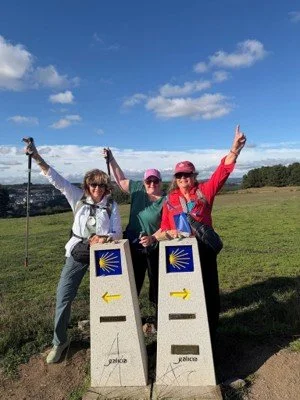
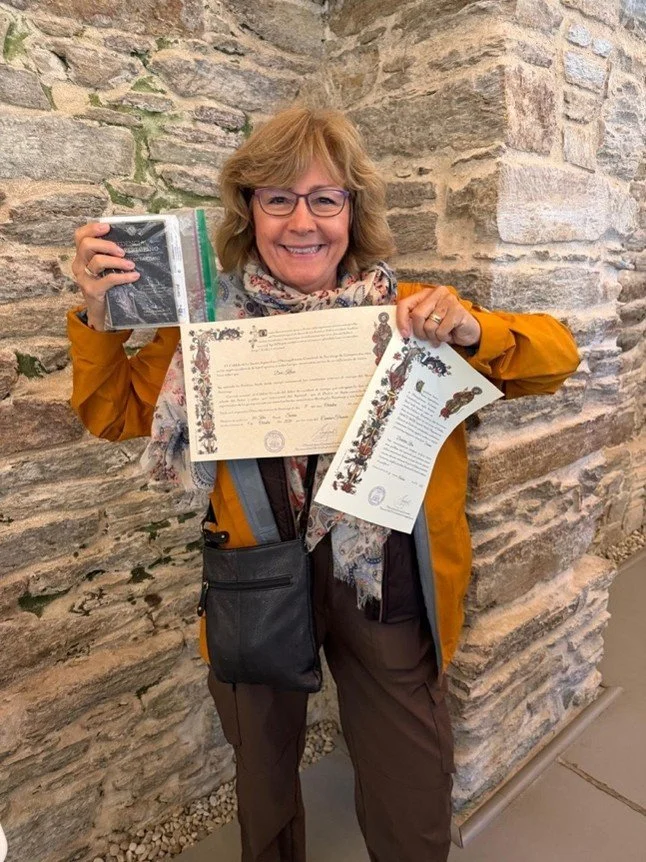
I have been home from Spain for several days now, although parts of me are still walking the Camino.
My suitcase has been unpacked. My clothes have been washed and put away. My sleep patterns are beginning – slowly - to reassemble themselves. I am returning to the rhythms and responsibilities of my everyday life without wanting to move too quickly past what happened there or what may still be happening within me because I went.
I am trying not to force the transition.
I spent enough of my earlier life in that energy: pushing through, making things happen, compelling myself to function, overriding what my body or heart might have been trying to tell me because something needed to get done - or because I had decided it needed to get done in a particular way and on a particular timeline.
These days, I am practicing grace, which requires a different kind of presence and the capacity not only to pay attention, but also to give attention. To be still and quiet long enough to notice what is here. To let the smiles come naturally. To bring a cadence and pacing to the work of daily life rather than treating every moment as something to manage, resolve or conquer.
Interestingly, just as much gets done.
Perhaps more importantly, I am more fully here for it.
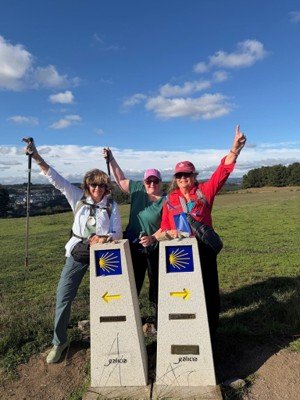
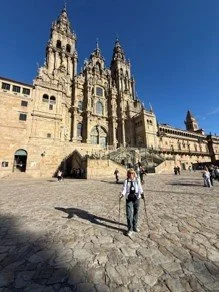
As I continue reflecting on the Camino I walked with my dear friends Kristina and Joanna, my heart keeps growing larger and more grateful.
And I miss them. I miss us as we were there - who we became together and who each of us was able to be while sharing the road.

Choosing to Leave the Familiar
One of the gifts of travel - and especially of a journey undertaken on foot - is that it removes us from many of the structures that ordinarily tell us who we are, what matters most and how the day is supposed to proceed.
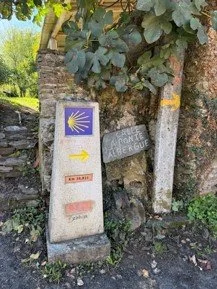
On the Camino, each day had a singular focus: to walk the path before us and make our way to the next town. Everything else circled and supported that intention - when we awakened, what we wore, what we carried, when we ate, where we rested and how we responded to whatever the path and weather placed before us.
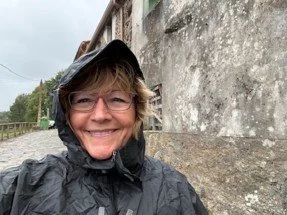
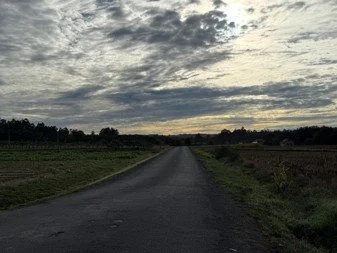
We walked in rain and sunshine, in conversation and silence, through villages, forests and open countryside. We shared the road with pilgrims from around the world, each carrying different stories and walking for different reasons - religious, spiritual, secular, personal or, perhaps, not yet entirely known.
Sometimes connection came through conversation or shared laughter. Sometimes it came simply through eye contact, a smile or the familiar greeting offered along the way:
Buen Camino.
Language barriers became less important with every step. Anxieties softened through movement, companionship and repetition. The unfamiliar became increasingly navigable because we kept meeting it, one foot in front of the other, discovering as we went what the day - and we - would require.
This is one reason it matters to do things that do not belong to our normal activities, settings or expectations. When we leave the familiar, even temporarily, we meet ourselves differently.
We discover capacities we may not use often enough to remember we possess. We notice where we are strong, adaptable and resilient, and we also encounter the places where we become impatient, frightened, rigid, controlling, over responsible or uncertain.
None of this is failure.
It is information - information about who we are, how we respond and what might be ready to grow.
Not All Discomfort Is the Same
I am calling this piece Celebrating Discomfort, although I want to be clear about what I mean.
I am not suggesting that suffering is inherently noble, that pain is required for growth or that we should remain in circumstances that diminish, endanger or deplete us. I am not interested in making a virtue of unnecessary hardship or encouraging anyone to override their own knowing in order to prove how strong they are.
Not all discomfort is productive.
Sometimes discomfort is telling us that something is wrong, a boundary has been crossed, or our physical or emotional safety is at risk. Sometimes the wisest and most self-honoring response is to stop, leave, rest, refuse or ask for help.
And there is another kind of discomfort: the natural friction created when we move beyond what is known and practiced, when we allow ourselves to become a beginner again or enter an experience whose outcome we cannot control.
It appears when we try something new, allow ourselves to be seen, speak honestly, travel somewhere unfamiliar or inhabit a different rhythm. It arises when we discover that our carefully constructed plan cannot account for what is actually happening and we must respond to the moment rather than to the moment we expected to have.
This discomfort occurs when our current capacities are being stretched - but not necessarily violated - and it deserves our curiosity.
It shows us the edges of the known: the places where habit no longer provides every answer, where mastery has not yet been established and where we must become more present to ourselves, one another and whatever is unfolding.
We do not have to enjoy every moment of discomfort to appreciate what it makes possible.
Perhaps celebrating discomfort does not mean throwing it a party or pretending that something difficult feels good. Perhaps it means honoring the courage required to meet it, paying attention to what it reveals and allowing ourselves to feel genuine satisfaction when we discover that we are more capable, resilient or resourceful than we knew.
Friction at the Edges of the Known
I experience a sacred journey as anything we dream into reality and then do the work required to bring to life - especially when that journey is undertaken in companionship with others.
The Camino was sacred space for me, sometimes experienced in an ordinary state and sometimes in a heightened one. The sacred and secular were not separate. They met in beautiful vistas and sore feet, shared meals and steady rain, laughter and silence, preparation and surprise.
They met in the act of walking.
Journeying provides something like fertilizer in a garden. It creates movement, disturbance and friction at the edges of what has become settled. That friction can nourish growth, awaken capacities that have gone unused and help us remain a creative force in our own lives.
We need some friction.
Our muscles require resistance to become stronger. Our thinking develops when it encounters a question it cannot immediately answer. Relationships deepen when they become capable of holding truth, difference, disappointment and repair. Businesses and communities grow when people can examine familiar assumptions, challenge ideas respectfully and remain present long enough for wiser possibilities to emerge.
Without friction, we may remain comfortable, but we may also become stagnant or increasingly narrow the boundaries of what we believe we can tolerate, attempt or become.
Too much friction, especially without adequate support or recovery, can overwhelm the system. Too little may leave important capacities undeveloped.
The work is not to pursue discomfort indiscriminately. It is to expand our capacity to remain present inside an appropriate degree of it - and to develop the discernment to recognize the difference.
Strength Is More Than Endurance
One of the most meaningful parts of the Camino was experiencing myself as strong.
Strong is one of my core values.
I felt strong, sturdy, solid and centered in my mind, heart, body, soul and relationships. I felt it with every day of walking and loved – LOVED - feeling, sensing and knowing it.
Given the periods in my life when I have felt physically, emotionally or spiritually wrecked, this experience brought grateful tears to my eyes. It affirmed something I believe deeply: our work to heal and grow matters. The ways we care for ourselves, build our capacities and find our way home to our bodies matter, even when progress is slow, nonlinear or difficult to see from inside the experience.
And yet, strength is not merely the capacity to endure more.
It is not gritting our teeth, refusing help or proving that we can carry everything alone. Strength includes knowing our limitations and recognizing when determination has crossed into self-abandonment. It includes adjusting our expectations when conditions change, protecting and supporting others when we are able and allowing ourselves to be protected, supported and held when we need it.
Strength includes vulnerability because vulnerability allows us to tell the truth about our actual experience instead of performing invulnerability.
This is as true in leadership, business and relationships as it is on a long walk.
A leader who cannot acknowledge uncertainty may cling to a failing plan because changing course feels like an admission of weakness. A business owner who associates strength with self-sufficiency may wait too long to ask for help. A partner who experiences every difference as a threat may try to avoid conflict until distance and resentment replace honest connection.
Endurance matters, but rigidity is not strength.
The deeper strength is the capacity to stay in relationship with ourselves, with one another and with what is actually happening - even when reality is not conforming to our expectations.
Building Conflict Competency
The ability to tolerate discomfort is central to what I think of as conflict competency.
Conflict competency does not mean enjoying confrontation or becoming skilled at winning arguments. It does not require aggression, emotional detachment or perfect composure.
It does require the capacity to hold tension without needing to resolve it prematurely.
This may be one of the most advanced and least appreciated skills of self-leadership: the ability to remain present in the unsettled space between what one person believes and what another person sees, between the answer we expected and the reality now confronting us, or between two apparently opposing truths that may both contain something important.
We are often in a hurry to make that tension go away.
We make a rapid decision, not because it is wise, but because deciding offers relief. We make a joke, change the subject, dismiss someone’s concern or reach for a familiar explanation. We declare one person right and another wrong. We rush toward strategy because taking action feels more comfortable than remaining in the uncertainty of what we do not yet understand.
I often say: Do not go to strategy too soon.
Sometimes the tension needs to be held - not indefinitely and not as a way of avoiding necessary action, but long enough for more information, more honesty and more possibility to emerge.
When we can resist the impulse to collapse the tension, a third truth may reveal itself: something neither person (or neither part within) could see from their original position, an option that was unavailable while everyone was defending certainty, or a deeper understanding that does not eliminate the difference but changes our relationship to it.
This requires us to become capable of not knowing.
It asks us to stay curious while our discomfort is urging us to reach a conclusion. It asks us to listen for what is underneath the stated position and to notice what is happening inside us without automatically making our internal reaction someone else’s fault.
Conflict competency is the capacity to listen without disappearing and to speak without attacking; to tolerate difference without treating it as disloyalty or rejection; to recognize when we need a pause and then return after the pause rather than using it to avoid what matters; to repair when we have caused harm or participated in a rupture; and to remain discerning enough to know when continued engagement is constructive and when a clear boundary or departure is required.
We build this capacity incrementally.
Every time we remain present during a difficult conversation instead of rushing to defend ourselves, we strengthen it. Every time we ask one more sincere question before settling on our interpretation, we strengthen it. Every time we communicate a boundary without requiring the other person to like it or discover that someone can disagree with us and the relationship can survive, we strengthen it.
And every time we allow ourselves to say, I do not know yet, without treating uncertainty as incompetence, we create room for a response that is more considered, more creative and more whole.
This is not simply a communication skill.
It is self-leadership: the capacity to remain in relationship with ourselves and others while something important is unresolved.
Prepare - and Leave Room for Mystery
We did not arrive in Spain without a plan.
There were travel arrangements, lodging reservations, carefully considered packing lists and physical preparations. We knew where we intended to begin, where we hoped to end and many of the steps required in between.
Preparation mattered. It made the journey possible.
And the plan was never the journey itself.
No amount of planning could determine the weather, the condition of the path, the conversations we would have, the people we would meet, the feelings that would arise or the meaning the experience would ultimately hold.
A plan creates direction and containment. It helps us commit resources, make choices and begin. But if we become too attached to the plan, we may miss the journey that is actually occurring because we are still trying to produce the one we imagined.
This is true whenever we are creating something - a business, a body of work, a relationship, a healthier life or a new chapter of identity.
We need vision, preparation and focused action. We need the willingness to place one foot in front of the other and to keep going when the work becomes less exciting than the dream.
And we need enough openness to respond to what we could not have predicted, including the possibilities that may be better, richer or more meaningful than anything we knew to plan for.
There is always mystery between the dream and its realization.
Leadership asks us to stand in that space: committed but not controlling or too attached, prepared but not rigid, discerning but still available to surprise.
Bringing the Camino Home
What I miss most about the Camino is its singularity.
Each day, our primary task was to walk. There was something profoundly clarifying about organizing the day around one meaningful intention and allowing everything else to support it.
Since returning home, Michael and I have begun walking together in the evenings. Sometimes we talk; sometimes we walk quietly. Either way, it has become connective and restorative - a lovely infusion of goodness into our individual lives and our life together.
Walking does that. Walking together amplifies it.
I cannot recreate the Camino here, nor do I want to turn a sacred experience into another set of performance expectations. But I can ask what the Camino wants me to remember and how I might bring its gifts into the life I am living now.
It invites me to be here, to give my attention to the person or task before me and to notice where I am strong. It invites me to become curious about the places where I still brace, force, control or retreat; to allow discomfort to teach me without automatically giving it authority over me; to prepare thoughtfully and then make room for mystery; and to welcome companionship, laughter, assistance and grace.
It reminds me, too, that the path does not reveal itself all at once.
We encounter it by walking.
October offers its own invitation into this kind of reflection. The seasons are changing here in the desert. The light and colors are becoming more vivid as the temperatures cool. Predator birds are active close to the ground, giving us a show almost every day. Seasonal residents are returning and lighting their homes anew.
Change is in the air.
It is not always comfortable, even when we have longed for it. The life we dreamed about may still require us to relinquish something familiar, tolerate uncertainty or become someone who can hold more truth, joy, responsibility or possibility than we could before.
But discomfort and joy are not mutually exclusive. Neither are uncertainty and strength, vulnerability and power, preparation and mystery.
Life can be extraordinarily hard. This is why pausing, acknowledging and celebrating what is good feels vital rather than frivolous. It restores balance. It reminds us to notice where our attention goes, to savor what is already here and to become a source of beauty and joy, too.
Perhaps we can welcome this season with open arms, a curious mind and a willingness to be stretched, while also experiencing it more fully by inviting its flavors, fragrances and particular pleasures into our lives - a literal dash of nutmeg, a little pumpkin spice and a warm mug of apple cider raised in a toast to the discomforts and joys of being fully alive.
May all that awakens your senses encourage you to remember who you actually are. And may you make time and space in your days to celebrate that.
Love,
Dori
Questions for Celebrating Discomfort
Why is discomfort important for personal growth?
Discomfort can reveal the edges of our existing habits and capacities. When it is appropriate, chosen or safely supported, it gives us opportunities to practice adaptability, courage, self-trust and resilience. Growth does not require constant discomfort, but it often asks us to remain present when something new or meaningful feels unfamiliar.
What is conflict competency?
Conflict competency is the capacity to remain present, curious and discerning when tension or disagreement arises. It includes regulating our reactions, holding tension without rushing toward premature resolution, listening without disappearing, communicating directly without attacking, tolerating different perspectives, establishing boundaries and repairing relational ruptures when possible.
Why is it important not to go to strategy too soon?
Moving too quickly toward strategy can provide immediate relief while preventing us from understanding the full situation. When we remain curious and hold tension long enough, additional information - or a third possibility that no one could initially see - may emerge. Thoughtful action is often more effective when it follows sufficient reflection, listening and meaning making.
How can leaders become more comfortable with uncertainty?
Leaders can prepare carefully while releasing the expectation that preparation will eliminate uncertainty. Practices such as pausing before reacting, distinguishing what is known from what is assumed, asking sincere questions and adjusting plans as new information emerges build the capacity to lead without requiring complete certainty.
How do I know whether discomfort is helping or harming me?
Helpful discomfort generally stretches your capacity while leaving room for agency, support, recovery and choice. Harmful discomfort may chronically diminish you, violate your boundaries, overwhelm your nervous system or compromise your physical or emotional safety. The goal is not to remain uncomfortable at any cost, but to respond with discernment.
How can I begin expanding my capacity for discomfort?
Choose one meaningful but manageable stretch: initiate an honest conversation, try an unfamiliar activity, ask for help, allow someone to disagree with you or spend time in a setting where you are not already competent. Pay attention to your reactions, use the support available to you and allow recovery to be part of the practice.
And perhaps the questions to sit with are these:
Where has comfort become restoration - and where may it have become limitation?
What kind of friction are you encountering at the edge of what you know?
What does discomfort reveal about your strengths?
Where might greater support, preparation or capacity be needed?
Where are you trying to relieve tension before you fully understand what it is asking of you?
What conversation, dream or change is asking you to remain present without knowing exactly how it will unfold?
What might become possible if you prepared well, stayed curious and left room for mystery?